
Cost & Practical Guides
Aluminium Sliding Window Security: Locks, Anti-Lift Blocks, Vent Latches & Security Screen Integration
By Sheng Xu · 25 September 2026
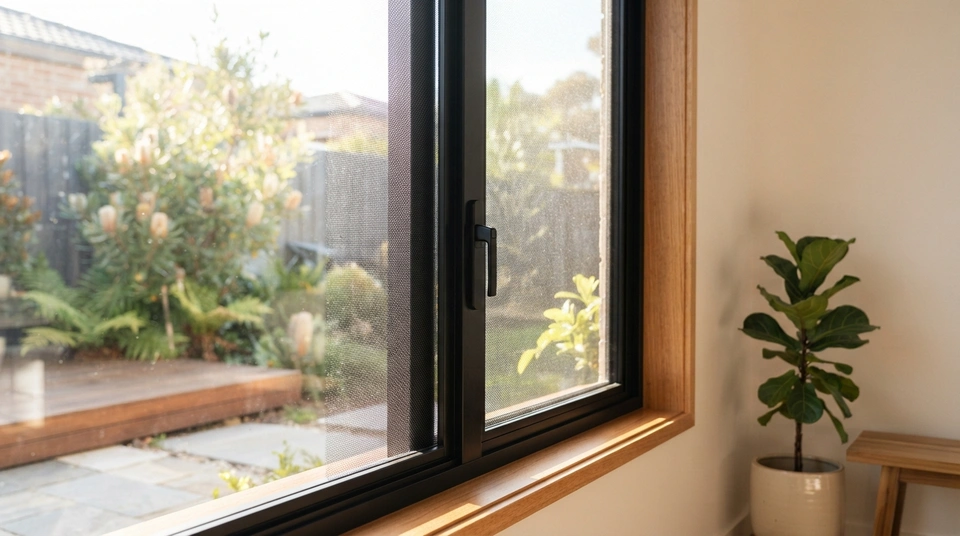
AI-generated illustrative image. Not a product test, certification record or project evidence.
Comprehensive home security for aluminium sliding windows requires a layered hardware ecosystem: twin-point mortise locksets with hooked deadbolts, internal anti-lift blocks to prevent external sash prying, key-lockable ventilation restrictors compliant with NCC D3D29 and AS 5203 fall prevention standards (125mm sphere rule and 250N force resistance), and seamless integration with AS 5039 certified 316 marine-grade stainless steel security screens.
In Australian residential security analysis, ground-floor and accessible upper-storey aluminium sliding windows are among the most frequently targeted points of forced entry. This vulnerability is rarely due to glass breakage—burglars actively avoid the noise and injury risk of shattering heavy float or laminated glass panels. Instead, intruders exploit mechanical weaknesses in budget hardware: flimsy surface-mounted plastic catches, unreinforced central meeting stiles, and standard installation tolerances that allow sliding panels to be lifted directly off their tracks.
True physical security for aluminium sliding joinery is achieved through a coordinated, multi-layered hardware ecosystem. In contemporary Australian architectural joinery, security hardware must not only resist determined intruder attacks under Australian Standards (AS 5039 and AS 4145) but must simultaneously satisfy mandatory life-safety and child fall prevention mandates under the National Construction Code (NCC D3D29 and AS 5203). This guide outlines the essential mechanical components, engineering standards, and installation detailing required to specify an impenetrable, fully compliant sliding window assembly.
The Upward Lift Attack: Defeating Track Prying with Anti-Lift Blocks
The single most common forced-entry technique used against residential aluminium sliding windows is the 'upward lift attack'. To understand this vulnerability, one must examine the basic installation mechanics of a sliding sash.
To allow a sliding sash to be installed into its frame during construction, the upper head channel of the outer frame must be extruded with approximately 12 to 15 millimetres of empty vertical clearance. Installers push the top of the sash deep into the head channel, swing the bottom rail over the sill track, and lower the sash onto its rollers. In budget builder-grade joinery, this 12mm to 15mm clearance pocket remains completely open over the lifespan of the window.
An intruder can insert a flat pry bar, cold chisel, or large screwdriver underneath the bottom aluminium rail from the outside. By levering the sash upward into the vacant head cavity, the bottom rollers rise clear of the raised sill track. Simultaneously, the single locking beak or surface catch disengages from its strike plate. The intruder swings the bottom of the sash outward and removes the entire glass panel from the wall in less than ten seconds, completely silently and without breaking a single pane of glass.
The Engineering Solution: Internal Anti-Lift Blocks. High-performance architectural sliding windows incorporate factory-fitted anti-lift blocks inside the upper head channel. Fabricated from high-density, UV-stabilized nylon or structural extruded aluminium, these blocks are fastened permanently directly above the closed position of the sliding sash. The block fills the vacant head pocket, reducing vertical sash play to less than 1.5 millimetres. When an intruder attempts to jemmy the bottom rail upward, the top of the sash immediately strikes the solid anti-lift block, transferring the leverage load directly into the structural timber wall framing and rendering the lift attack physically impossible.
Locking Mechanisms: Surface Latches vs. Twin-Point Mortise Hook Locks
The locking hardware fitted to an aluminium sliding window directly dictates its resistance to lateral crowbar prying and forced jimmying. In the Australian market, locking hardware falls into three distinct security tiers:
Tier 1: Surface-Mounted Cam Catches
Commonly installed on budget residential windows, surface cam catches consist of a plastic or die-cast zinc lever screwed onto the face of the sliding sash stile, engaging a stamped metal strike plate on the outer frame. Because they are secured with short self-tapping screws driven into thin 1.2mm aluminium extrusion hollows, a moderate lateral pry with a screwdriver easily strips the screws or snaps the zinc cam tongue.
Tier 2: Key-Lockable Flush D-Pulls
A standard residential upgrade, flush D-pull locks feature a key-operated cylinder and a hardened steel locking pin. While offering significantly better security than basic cam catches, single-point pins can still be vulnerable to spreading attacks if the outer frame flexes away from the sash under heavy outward leverage.
Tier 3: Twin-Point Mortise Hook Locks
The architectural benchmark for maximum forced-entry resistance is a twin-point mortise lockset (such as commercial suites by Lockwood, Doric, or Austral). The lock body is fully concealed inside the hollow vertical sash stile extrusion. Operating the key cylinder or interior safety snib throws dual opposing, heavy-gauge stainless steel hooked deadbolts deep into a reinforced, extruded receiver pocket inside the side jamb.
Because the two stainless steel hooks throw in opposite vertical directions (one hook pointing upward, one hook pointing downward), the lock deadlocks the sash against three-dimensional forces: it cannot be pulled laterally away from the jamb, pushed outward through the opening, or jacked vertically upward off the sill. Certified to Australian Standard AS 4145 (Mechanical locksets for doors and windows), twin-point mortise systems provide bank-grade resistance against mechanical prying.
Child Fall Prevention & Night Ventilation: NCC D3D29 & AS 5203
In Australian residential design, home security must be seamlessly integrated with life-safety regulations designed to prevent accidental falls. Under National Construction Code (NCC 2022) Volume One Part D3D29, Volume Two Part H4D6, and NSW Strata Schemes Management legislation, openable windows in bedrooms where the internal floor level is 2 metres or more above the external surface must be fitted with fall prevention hardware.
Australian Standard AS 5203:2016 (Protection of openable windows/fall prevention) establishes the strict testing protocol that window restrictors must satisfy:
1. The 125mm Sphere Rule: The window opening must be physically restricted so that a rigid 125 millimetre diameter sphere cannot pass through any part of the open aperture.
2. The 250 Newton Force Test: The restrictor hardware, its mounting screws, and the aluminium frame itself must withstand a continuous static outward horizontal force of 250 Newtons (approximately 25.5 kilograms of pressure) applied directly against the sash and restrictor without failing or allowing the gap to widen past 125mm.
Dual-Position Key-Lockable Vent Restrictors provide the optimal solution for both home security and child safety. These secondary track locks (such as Remsafe or Doric vent locks) feature a keyed locking pin that engages into two machined index holes along the top or bottom track. In Position 1, the window is deadlocked fully closed. In Position 2, the window is locked securely at an exact 100 millimetre opening.
This 100mm locked position allows fresh evening breezes to cross-ventilate bedrooms while preventing intruders from crawling inside and eliminating the risk of young children falling through the opening. Crucially, AS 5203 mandates that any override mechanism allowing the window to open fully beyond 125mm must be child-resistant (requiring a specialized key, a tool, or a coordinated two-handed adult release action) to guarantee that adults can open the window fully during a structural fire or building evacuation.
Security Screen Integration: AS 5039 / AS 5041 Stainless Steel Mesh
Standard fiberglass or nylon insect fly screens are designed purely to exclude insects; they offer zero structural resistance against intruders, tears, or pets, and cannot be used to satisfy NCC fall prevention mandates. For true physical security, aluminium sliding windows should be paired with certified security screens.
In Australia, genuine security screens must comply with Australian Standard AS 5039 (Security screen doors and security window grilles) and undergo independent NATA-accredited testing under AS 5041 across four rigorous physical trials:
Dynamic Impact Test: The screen must withstand five consecutive blunt impacts of 100 Joules of kinetic energy from a heavy swinging test bag, simulating an intruder attempting to kick or body-charge through the screen.
Jemmy Test: A mechanical wedge and lever apparatus applies sustained prying force against the screen frame edges to test retention resistance.
Pull Test and Knife Shear Test: The screen mesh must withstand heavy pulling forces and three continuous passes of a heavy-duty mechanical utility blade without tearing or shearing.
High-performance security screens utilize woven, high-tensile 316 marine-grade stainless steel wire mesh (typically 0.8mm to 0.9mm wire diameter) anchored into heavy-gauge aluminium perimeter frames using mechanical clamping, high-pressure wedging, or high-adhesion structural aerospace bonding. Modern architectural sliding window suites feature integrated exterior frame receiver channels that allow AS 5039 security screens to drop flush into the joinery, eliminating the need for unsightly pop-riveted surface angle brackets while preserving clean exterior architectural sightlines.
Meeting Stile Interlocks and Anti-Jemmy Baffles
On two-panel (XO), three-panel (XOX), and four-panel (OXXO) sliding windows, the central vertical meeting stile where sashes overlap represents a prime target for spreading attacks. Intruders frequently attempt to insert a wide pry bar between the meeting stiles to force the panels apart.
Architectural sliding joinery defends against this through full-height structural interlocks. Both overlapping vertical extrusions incorporate deep, hooked aluminium profiles that interlock across their entire vertical height from head to sill. When closed, pulling or pushing against the center of either panel merely pulls the interlocking hook tighter.
In addition, high-security systems incorporate internal anti-jemmy baffle strips and molded PVC block inserts within the interlock cavity. These baffles prevent intruders from inserting thin, flexible wire probes or plastic shims through the weatherstripping from the outside to manipulate interior latch handles or flip vent lock release levers.
Frequently Asked Questions
How do intruders break into aluminium sliding windows without breaking glass?
Intruders exploit the 12mm to 15mm vertical clearance in the upper head channel required for sash installation. By inserting a pry bar under the bottom sash rail and levering the panel upward, the bottom rollers rise off the sill track, disengaging the lock catch and allowing the entire glass sash to be pulled out of the frame in under ten seconds.
What are anti-lift blocks and how do they prevent break-ins?
Anti-lift blocks are precision-molded nylon or aluminium blocks fastened permanently inside the upper head track directly above the closed sliding sash. They restrict vertical sash movement to less than 1.5mm, preventing intruders from levering the bottom rollers upward off the track.
What are the NCC child fall prevention requirements for upper-storey windows?
Under NCC 2022 Volume One Part D3D29, Volume Two Part H4D6, and Australian Standard AS 5203:2016, openable windows in bedrooms where the internal floor level is 2 metres or more above the external surface must be restricted so a 125mm sphere cannot pass through, resisting a static outward force of 250 Newtons. Key-lockable vent restrictors typically lock sashes at an exact 100mm opening, providing compliant ventilation.
What is the difference between an insect fly screen and an AS 5039 security screen?
Standard fly screens are made of light fiberglass or nylon mesh designed only to block insects and offer zero resistance against physical force or human falls. A genuine security screen must comply with AS 5039 / AS 5041, utilizing high-tensile 316 marine-grade woven stainless steel wire mesh anchored into a reinforced aluminium frame, capable of passing heavy dynamic impact and knife-shear tests.
Master Sliding Window Security Specification Checklist
When specifying hardware or signing off on a window fabrication schedule, verify that your aluminium sliding windows incorporate this six-point security hardware package:
1. Anti-Lift Blocks: Are factory-molded nylon or aluminium anti-lift blocks fitted inside the upper head channel directly above every sliding sash to limit vertical play to under 1.5mm?
2. Mortise Deadlocks: Is the primary lock a twin-point mortise lockset with dual opposing stainless steel hooked bolts engaging into an internal extruded jamb pocket?
3. Fall Prevention Vent Restrictors: On upper-storey bedroom windows (where floor level is ≥ 2m above ground), are key-lockable vent restrictors installed that restrict opening to 100mm under a 250N force per NCC D3D29 and AS 5203?
4. Child-Resistant Override: Does the vent restrictor incorporate a key-operated or child-resistant release to allow full sash opening for emergency fire egress?
5. Certified Security Screens: Are exterior screens manufactured from 316 marine-grade stainless steel woven mesh certified to AS 5039 / AS 5041 standards and fitted flush into integrated frame channels?
6. Key-Alike Convenience: Are all window lock cylinders and vent restrictors keyed-alike across the entire home, ensuring that a single master key operates all window hardware during daily use and emergency exits?
Our Products
Sliding Windows
View system
Awning Windows
View system
Louvre Windows
View system
Fixed Windows
View system
Sliding Doors
View system