Screens & Security
What is security mesh for windows and doors?
By Sheng Xu · 2 August 2026
AI-generated illustrative image. Not a product test, certification record or project evidence.
Security mesh for windows and doors is a woven steel fabric fitted inside an aluminium frame. It is designed to enhance home security and resist bushfire embers, and it forms a far stronger barrier than a standard fibreglass insect screen. It matters most in bushfire-prone areas and wherever a home's openings face a real break-in risk.
Security mesh for windows and doors is a woven steel fabric stretched inside an aluminium frame, built to do two jobs at once: slow down an intruder, and in bushfire-prone parts of Australia, stop burning embers from reaching the inside of the home. The weave is far stronger than a standard insect screen, yet fine enough to keep views clear and breezes moving. This guide covers how it works, the standards behind it, what it costs in 2026, and where its limits are.
What is security mesh for windows and doors?
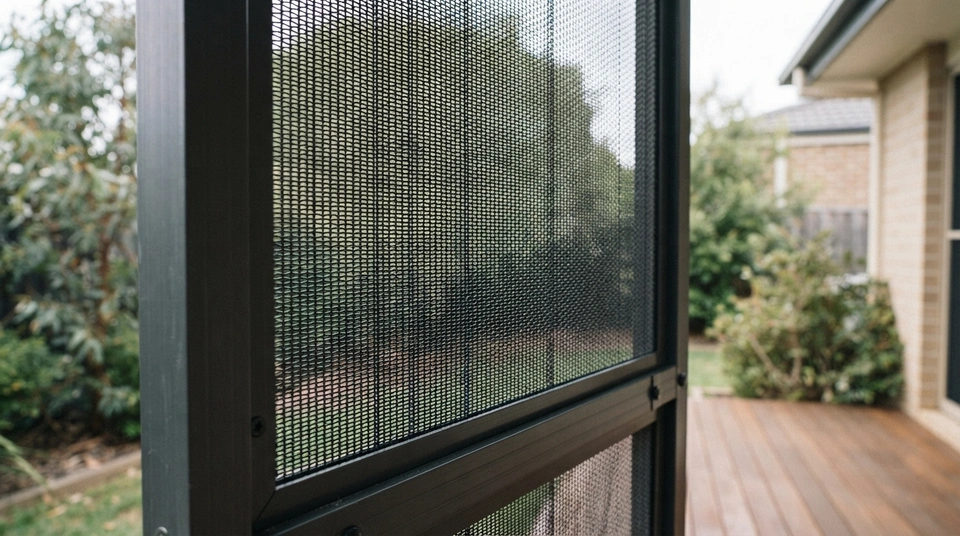
Security mesh is woven stainless steel fitted to the outside of a window or door opening. The steel is drawn into thin wire, woven on a loom into a tight uniform grid, then stretched and clamped mechanically into an aluminium frame. Most Australian systems use 316 marine-grade stainless steel, which holds up to coastal salt air and the chemicals used to clean it. The wire is typically around 0.8 mm thick, and the finished weave keeps an open area of roughly 40 per cent, which is why a security screen still lets light through and air move.
On a window, the screen covers the openable sash. On a door, it replaces the flyscreen layer, so the solid door can stand open for airflow while the mesh holds the line. In the protection ladder, mesh sits between an insect screen and steel bars: much stronger than fibreglass, without the prison look of bars.
How is security mesh different from an insect screen?
Start with the material and the fixing. An insect screen is woven fibreglass or aluminium, soft enough to cut with a knife, and held in its frame by a rubber spline. Security mesh is woven high-tensile steel, clamped mechanically so it cannot be pushed out of the frame the way a flyscreen pops out of its groove.
The second difference is testing. A flyscreen has no security role. Under the Australian standards system, a product can only be sold as a security screen if it has been tested to AS 5039, which sets out how the mesh, frame and fixing must perform under attack; screens that pass carry a label fixed to the frame. A door sold as a security door that fails this test is a flyscreen with a heavier frame, and it behaves like one when someone leans on it.
Fibreglass also degrades. Sun and weather loosen insect mesh until it sags, tears and lets the insects back in. Steel weave keeps its tension, which is why mesh screens still look and perform the same years after installation.
What materials and standards matter?
Two mesh constructions dominate the Australian market. Woven stainless steel is what most people picture: strands of 316 stainless woven like fabric, with the best combination of airflow, visibility and insect exclusion. Perforated aluminium is a solid sheet with holes punched through it. It gives more privacy and a different look, but less airflow, and it is usually chosen where security requirements are lighter.
Wire thickness is a real specification choice. Most systems use 0.8 mm wire; some use 0.9 mm and claim extra strength. Thicker is not automatically better, because it adds weight, and a sliding door track not engineered for it will sag and bind over time. Ask which wire the quote actually specifies, and whether the frame and track are designed for it.
The standards to look for are AS 5039 for the screen itself and AS 5040 for installation. Compliance is not optional marketing. Screens that pass carry the AS 5039 label on the frame, and the National Security Screen Association publishes the list of products and installers that meet its quality criteria. If the label is missing, the product has not been tested as a security screen.
Mesh can also satisfy a building-code requirement. The NCC's protection of openable windows recognises a screen that is securely fixed to the frame, for example pop-riveted in place, as a permanent barrier, which means mesh can cover what would otherwise need restrictors or bars.
Can security mesh stop a break-in?
The honest answer is that a security screen is a deterrent layer, not a guarantee. Its job is to make an opening harder to get through than the one next door, and to buy time while an intruder decides this house is not the easy option.
In most screen doors, the weak point is the lock, not the mesh. Practitioners are blunt about this: a traditional screen-door lock can be opened in seconds with a pair of vice grips and a pick, whatever the brand. If the lock is the first thing an intruder can reach, spend the money there first, and treat the mesh as the layer behind it.
Installation quality counts as much as product quality. A screen fitted to an out-of-plumb frame, with corners cut to make it close, has already given up some of its strength. If the installer is modifying parts on site to make a door close, that is a red flag, not an acceptable workaround.
One limit applies to every brand: mesh protects only the sash it covers. On a sliding window, the screen covers the moving pane; the fixed pane is still glass, and glass next to mesh can be broken. Security mesh is one layer in a home security plan, not the whole plan.
What does security mesh do in a bushfire?
In bushfire-prone areas, mesh is part of how a building keeps embers out. Under AS 3959, the standard for buildings in bushfire-prone areas, windows in BAL-12.5 to BAL-29 zones must be protected by screens with a maximum aperture of 2 mm, made of corrosion-resistant steel, bronze or aluminium. From BAL-19 up, the screen assemblies must be attached with metal fixings, not plastic or adhesive.
The mechanism is worth understanding. Embers fly kilometres ahead of the flame front, and a screen with a sub-2 mm aperture stops them from entering through open or broken windows. A fibreglass flyscreen in the same conditions can melt, warp or burn through, opening a path for embers to reach the interior. Steel mesh also protects the glazing itself, absorbing radiant heat and debris impact that would otherwise crack the glass, which is why some products are rated for ember attack up to BAL-40.
One nuance: at most BAL levels the standard does not require screening on openable doors, but if a door is screened, the same 2 mm corrosion-resistant mesh applies. Because the mesh is specified as part of the whole window and door assembly, the screen choice belongs in the building specification, not left to whoever fits the door later.
What does security mesh cost?
Industry pricing in 2026 puts a custom-made, standard-size single security screen door at roughly $1,100 to $1,600 installed. Perforated aluminium versions sit at the lower end, around $1,100 to $1,400, while woven 316 stainless steel runs about $1,400 to $1,500 for the same door, because the material and the tensioning system cost more.
Windows are where the budget multiplies, because the price is per opening. Homeowners who have been through the quoting process report full-house fitouts landing between $11,000 and $20,000 for a typical home, depending on the number of openings, the mesh type and the difficulty of the framing. A $20,000 window quote sounds absurd until you count the openings.
The price pays for custom sizing and manufacturing, the mesh type, the locking hardware and installation. Out-of-square frames, heritage profiles and hard-to-reach windows all add labour. The way to keep control is to price per opening, ask for itemised quotes, and compare like for like: the same mesh type, the same lock specification and the same fixing method.
What to check when buying and installing
Four checks separate a real security screen from a dressed-up flyscreen. First, the AS 5039 label on the frame; without it, the product has not been tested and it is not a security screen. Second, the lock specification: a three-point lock or a deadbolt separate from the main latch, because the lock is the most attacked part of the door.
Third, the installer: NSSA membership and a history of measured installs, because a screen fitted to an out-of-square frame is a weakened screen. Fourth, maintenance: wash the mesh with mains water, a soft cloth and a car-wash product, then rinse, and do not let salt or iron-ore dust burn into the powder coat. On windows, screens that are pop-riveted in are effectively permanent, so clean the glass from inside by lifting the sliding panel out.
Frequently asked questions
Is security mesh worth it?
A security screen is worth it when the opening faces a real threat, when the home is in a bushfire-prone area, or when you want to leave doors and windows open without feeling exposed. It is not worth the premium if the lock stays weak, because the lock, not the mesh, is what a determined intruder attacks first.
What is the difference between security mesh and a flyscreen?
A flyscreen is fibreglass or aluminium held in its frame with a spline, and it keeps insects out. Security mesh is woven steel, mechanically clamped, tested to AS 5039, and built to resist forced entry and embers. A flyscreen has no security role; a security screen also keeps insects out.
Does security mesh protect against bushfires?
Yes, when it is specified to AS 3959. Screens with a maximum aperture of 2 mm in corrosion-resistant steel, fixed with metal fixings from BAL-19 up, block the embers that fly kilometres ahead of the fire front. Fibreglass flyscreens melt or burn through in the same conditions.
How do I know if my security screen is compliant?
Look for the AS 5039 label fixed to the frame, confirm the installer's NSSA membership, and keep the product documentation. If the label is missing, the product has not been tested as a security screen.
The bottom line
Security mesh earns its place in the specification because it solves three problems at once: it resists intruders, it blocks embers in bushfire-prone areas, and it lets a home stay open to the air. Its limits are just as real, and the mesh is only as strong as the lock beside it and the installer behind it. Specified to AS 5039 and fitted as part of the whole window and door assembly, it is the most effective single upgrade most Australian homes can make to a vulnerable opening. SMIRO can review the openings on a project and help with the specification.