Policy
How do windows and doors achieve NCC 2022's 7-star NatHERS rating?
By Sheng Xu · 30 August 2026
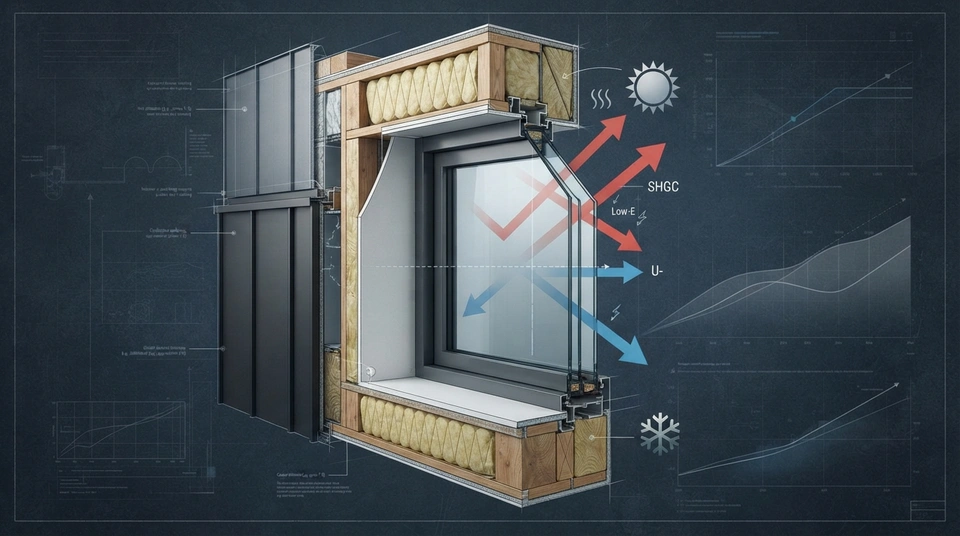
AI-generated illustrative image. Not a product test, certification record or project evidence.
NCC 2022 mandates a 7-star NatHERS rating for new homes, requiring high-performance glazing and thermally broken frames to manage heat transfer. While double glazing isn't always mandatory, optimising window properties like U-value and SHGC, alongside design choices such as orientation and size, is crucial. This approach helps reduce energy bills and improve comfort across Australia's diverse climate zones.
Under the National Construction Code 2022 (NCC 2022), the minimum thermal performance standard for new Australian homes stepped from 6 to 7 stars out of 10 under the Nationwide House Energy Rating Scheme (NatHERS). While standard single-glazed clear glass in basic aluminium frames could routinely scrape across the 6-star threshold with extra ceiling batts, it is practically impossible to achieve 7 stars in most Australian climate zones without upgrading windows and doors. Glazing represents roughly 8% to 12% of an average home envelope area, yet it accounts for up to 40% of winter heat loss and as much as 87% of peak summer heat gain. In a 7-star assessment, windows and doors are no longer an afterthought: they are the primary lever that decides whether a home passes or fails compliance.
Why the extra star makes windows the central battleground
The jump from 6 stars to 7 stars sounds incremental, but mathematically it represents an average 20% to 25% reduction in the annual thermal energy required to heat and cool a home. In colder regions like Melbourne (Climate Zone 6) or Canberra and Hobart (Climate Zone 7), that 1-star leap demands a substantial drop in heating load (measured in megajoules per square metre per year). In warmer zones like Brisbane (Climate Zone 2), it demands aggressive cooling load abatement.
Building envelope elements such as roofs, ceilings, and external walls quickly hit diminishing returns. Moving ceiling insulation from R4.0 to R6.0 adds only fractional efficiency gains, and standard 90mm wall cavities physically limit how much bulk insulation can be installed without thickening studs. Glazing, by contrast, has historically been Australia’s thermal weak link. Industry data from Glassworks indicates that prior to NCC 2022, approximately 70% of new residential builds settled for basic single-glazed aluminium windows. Replacing that conductive glass and framing with performance glazing delivers immediate, measurable gains in NatHERS star ratings.
The architectural scale of glazing also shapes the compliance math. Technical research by the Australian Glass and Window Association (AGWA) highlights that volume home designs with a disciplined Window to Floor Area Ratio (WFAR around 20%) can often reach 7 stars with selective single Low-E or standard double glazing. However, contemporary custom homes with WFAR exceeding 27% to 28% create extensive heat transfer pathways that cannot be compensated for through ceiling or wall insulation alone, making high-performance glazing assemblies mandatory.
Importantly, NCC 2022 structures energy compliance into a two-tier framework. This guide details Tier 1: achieving the 7-star NatHERS building fabric requirement through window and door selection. For Tier 2 compliance—the separate annual energy budget regulating heat pumps, air conditioning sizing, and rooftop solar trade-offs—see SMIRO's companion guide: NCC 2022 Whole of Home Energy Budget.
The core glazing metrics: whole-window Uw and SHGC
NatHERS software does not assess glass in isolation. It rates the entire manufactured assembly: glass panes, gas fills, spacer bars, seals, and the perimeter frame. The two metrics that determine compliance are whole-window U-value (Uw) and Solar Heat Gain Coefficient (SHGC).
Whole-window U-value (Uw) measures conductive heat transfer through both the glass and the frame. The lower the Uw, the better the window insulates against outdoor temperature extremes. Standard single-glazed aluminium windows sit around 6.0 to 7.0 W/m²K. To achieve 7 stars, typical specifications require whole-window Uw values between 2.8 and 4.5 W/m²K, and down below 2.2 W/m²K in colder southern climates.
Solar Heat Gain Coefficient (SHGC) measures the fraction of solar radiation passing through the opening, expressed as a number between 0 and 1. A high SHGC (0.50 to 0.70) lets abundant solar heat into the building, which is highly advantageous for north-facing windows during chilly southern winters. Conversely, a low SHGC (0.20 to 0.35) blocks solar radiation, which is critical for west-facing elevations and hot northern climates to prevent severe summer overheating.
Climate zones dictate the window recipe: heating versus cooling dominance
Australia spans eight distinct NCC climate zones, and what scores 7 stars in Brisbane will cause a compliance failure in Melbourne. A comprehensive 7-Star technical investigation by AGWA, evaluating a parametric matrix of 433 representative WERSLink windows across 9 climate regions, proves that window selection must match the dominant local thermal load.
In cool and cold climates (Zones 6, 7, and 8 - Melbourne, Ballarat, Canberra, Hobart), heating dominates the annual energy load. Here, the primary objective is preventing conductive heat loss through the glass and frame while capturing solar gain. The proven recipe is double glazing with low whole-window Uw (typically 2.4 to 3.5 W/m²K), paired with moderate-to-high SHGC (0.45 to 0.60) on north-facing living areas. Restricting solar gain too aggressively in Melbourne actually penalises the NatHERS score because it forces artificial heating during sunny winter days.
In warm and tropical climates (Zones 1 and 2 - Darwin, Brisbane, Sunshine Coast), cooling dominates. Window selection focuses on stopping solar radiation before it enters the building. Low whole-window SHGC (under 0.35) using tinted or solar-control Low-E glass is essential. Upgrading U-value offers diminishing returns in these zones compared to solar blocking, deep external eaves, and maximising openable window area for evening cross-ventilation.
In temperate and mixed climates (Zones 4 and 5 - Sydney, Adelaide, Perth), heating and cooling loads are balanced. University of Melbourne research into residential glazing upgrades found that moving from standard single clear glass to a performance Low-E double-glazed assembly improved NatHERS ratings by 1.0 full star in Melbourne and up to 1.6 stars in Brisbane, illustrating how solar control and thermal insulation interact across latitudes.
Orientation-specific specification: avoiding the costly blanket upgrade
A common mistake in volume home building is specifying identical glass and frames across every elevation. AGWA’s technical findings confirm that tuning window specifications by facade orientation achieves 7-star compliance at substantially lower cost than a blanket whole-house upgrade.
North-facing elevations receive high-angle sun in summer and low-angle sun in winter. They should feature generous glazing with higher SHGC (0.50+) and properly calculated roof eaves (typically 450mm to 600mm). In winter, the low northern sun pours in free radiant heat; in summer, eaves shade the glass completely.
West-facing elevations represent the severe overheating hazard in Australian homes. Afternoon summer sun strikes low beneath standard eaves with intense radiation. West-facing windows should be kept modest in size, fitted with low-SHGC glass (under 0.30), or protected by external shading screens and awnings. High-SHGC clear double glazing on an unshaded west wall can drag a 7-star design down by half a star on cooling penalties alone.
East-facing windows catch morning sun and require moderate SHGC to balance light and summer morning heat gain. South-facing windows receive zero direct winter sun and contribute pure conductive heat loss. On southern elevations, window sizes should be disciplined, and whole-window Uw should be driven as low as possible through double glazing, while SHGC is secondary.
The software secret: custom WERS ratings versus default penalties
Many designs that initially fail 7-star assessment can pass without moving a wall or shrinking a single window, simply by fixing how the windows are entered into the energy rating software. This software mechanism is widely known among experienced NatHERS assessors but frequently overlooked by builders.
NatHERS software tools (AccuRate, FirstRate5, BERS Pro, HERO) contain two ways to specify windows: generic defaults or custom products from the WERSLink database. Software defaults are intentionally conservative to account for worst-case uncertified manufacturing. A generic default aluminium double-glazed window might carry an assigned Uw of 4.5 and an adverse air infiltration rating in the calculation model.
When an assessor swaps generic defaults for verified custom WERS test certificates from certified manufacturers (such as tested AS 2047 compliant aluminium suites with known Uw of 3.2 and low air leakage), the software recalculates the building envelope using true performance values. In practice, this single paperwork adjustment regularly recaptures 0.3 to 0.7 stars on the certificate, resolving marginal non-compliance without construction cost.
This software strategy brings an essential compliance obligation known across industry forums as the 'Model versus Build' gap. Under NCC 2022, private building certifiers increasingly audit delivered window stickers and manufacturer delivery dockets directly against the NatHERS stamped glazing schedule. If an assessor specifies a custom WERS window with a Uw of 3.1 and SHGC of 0.48 to clear 7 stars, the builder cannot substitute unrated generic windows on site. Doing so invalidates the energy report and can stall the occupancy permit.
Frame selection, condensation, and thermal breaks
Is thermally broken aluminium mandatory to achieve 7 stars? The short answer is no. Standard (non-thermally broken) aluminium frames fitted with double glazing or single-glazed Low-E glass can comfortably hit 7 stars on well-oriented homes with standard Window to Floor Area Ratios (WFAR around 20%).
However, standard aluminium is an efficient conductor of heat (thermal conductivity around 160 W/mK). As architectural designs increase glass area - especially double-storey homes with large open-plan living rooms and WFAR exceeding 25% to 28% - standard aluminium frames encounter a thermal barrier. In Climate Zones 6, 7, and 8, the heat conducting through the metal frame offsets the gains of the insulated glass unit.
Frame conduction also directly impacts condensation and indoor mould, an issue addressed under NCC 2022 Part 10.8 condensation management provisions. In uninsulated aluminium frames during cold winter nights, the internal metal surface temperature drops below the indoor dew point, causing persistent water pooling on window sills that fosters toxic black mould growth. Thermally broken aluminium frames solve this by inserting a low-conductivity polyamide barrier (typically PA66-GF25, conductivity around 0.3 W/mK) between the internal and external aluminium profiles. This drops whole-window Uw below 2.5 W/m²K, keeps internal frame surfaces warm, virtually eliminates condensation, and provides the thermal headroom necessary for expansive architectural sliding and stacking door systems.
Real-world cost realities: what 7-star compliance actually adds
During regulatory consultation, the Australian Building Codes Board (ABCB) estimated that the 7-star thermal shell upgrade would add between $3,000 and $5,000 to the construction cost of a typical detached single-storey home. Real-world quoting and build variations collected across Australian practitioner forums and HomeBuild HQ in 2026 reflect a broader spectrum based on design discipline.
Where a home is designed from the sketch stage with solar passive principles - living areas facing north, modest west and south glazing, and 450mm to 600mm eaves - builders in Queensland and northern NSW report compliance variations under $2,500. Often, upgrading to low-E single glazing or entry-level double glazing on bedrooms is sufficient.
Conversely, on tight suburban blocks with poor solar orientation or heavily glazed west facades, variations regularly reach $6,500 to $10,000+. On a 220m² single-storey build in Adelaide or Melbourne, typical compliant variation packages include double glazing across living areas, Low-E glass on south and west openings, upgraded ceiling batts (R5.0 to R6.0), and tight perimeter draught sealing.
The long-term return on this glazing investment is substantial. Australian government and GBCA data indicates that an energy-efficient 7-star thermal shell reduces heating and cooling energy consumption by 20% to 30% compared to a 6-star baseline, saving $300 to $450 annually on utility bills, dampening external street noise, and eliminating the chronic interior window condensation that causes mould growth.
Frequently Asked Questions
Is double glazing mandatory to achieve a 7-star NatHERS rating?
No. The National Construction Code sets a performance outcome for the entire building envelope rather than prescribing specific products. In warmer regions like Brisbane, or on well-designed homes with disciplined window areas, optimal northern orientation, and deep eaves, it is possible to achieve 7 stars using high-performance single-glazed Low-E glass. However, in cooler and cold climates (Melbourne, Canberra, Hobart, Ballarat, and Adelaide), high-performance double glazing is practically unavoidable on most elevations to meet mandatory winter heating load limits.
Will 7-star energy standards force homes to have smaller windows?
No. NCC 2022 does not impose arbitrary maximum limits on window sizes or glass-to-floor ratios. What the code changes is the required performance level of the glazed openings you choose to specify. If an architectural plan features expansive floor-to-ceiling glass or multi-panel sliding doors, compliance is achieved by upgrading the assembly performance (such as specifying thermally broken aluminium frames with argon-filled Low-E double glazing) rather than shrinking the opening.
Do 7-star energy standards increase the risk of condensation and mould?
When properly detailed, 7-star construction significantly reduces condensation. Upgrading from standard single glazing to double glazing and thermally broken aluminium frames raises the interior surface temperature of the glass and metal, keeping it comfortably above the indoor air dew point where water vapour condenses. NCC 2022 also introduced updated Part 10.8 condensation management provisions, ensuring tighter building envelopes incorporate dedicated exhaust ventilation and vapour-permeable wall membranes.
What is the difference between WERS default and custom windows in NatHERS?
In NatHERS rating software, default windows represent conservative, worst-case industry assumptions used when specific product test data is unavailable, applying a 10% to 15% safety penalty to whole-window U-values and assuming higher air leakage. Custom windows represent laboratory-tested products certified in the WERSLink database. Supplying your energy assessor with verified test certificates from an Australian manufacturer routinely recaptures 0.3 to 0.7 stars on the assessment certificate without altering the physical design.
How much extra does 7-star compliant glazing add to a new home build?
According to reporting from the Australian Glass and Window Association (AGWA) and the Green Building Council of Australia (GBCA), meeting 7-star energy efficiency standards has raised average construction costs by approximately $4,300 per home. On well-oriented single-storey builds, variations can be as low as $2,000 to $2,500. On complex two-storey designs with unshaded west-facing glazing in southern states, variations can reach $8,000 to $10,000. This upfront cost is offset by an estimated $300 to $450 in annual energy bill savings.