
Energy & Thermal Performance
Are Slimline Aluminium Windows Energy Efficient? Thermal Break Limits and 7-Star Strategy
By Sheng Xu · 2 October 2026
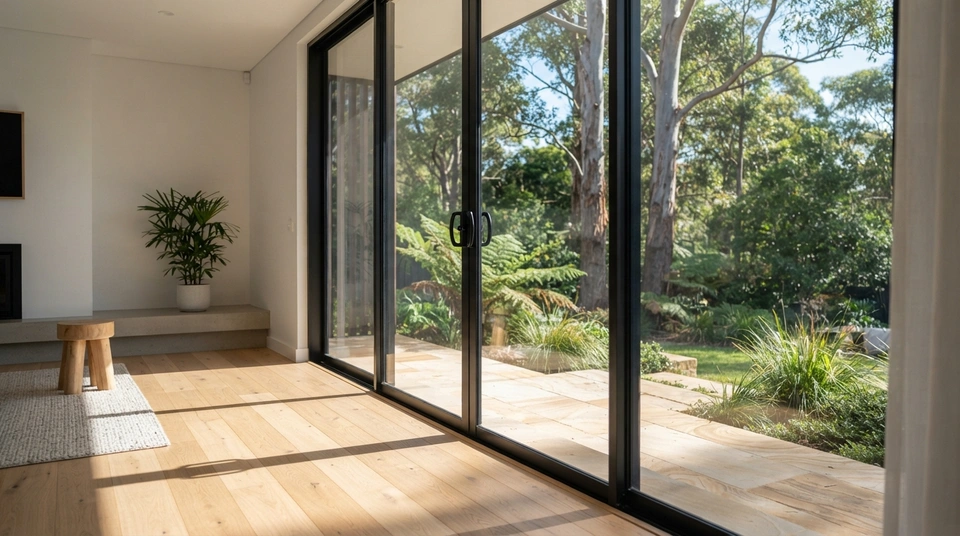
AI-generated illustrative image. Not a product test, certification record or project evidence.
Slimline aluminium windows can be energy efficient, but frame width is not what decides it. Performance depends on the whole-window U-value, the solar heat gain coefficient, the glass specification and whether the narrow frame keeps a well-designed thermal break. Under NCC 2022 7-star, windows are modelled within the whole home, so large two-storey designs with lots of glass are the most likely to need Low-E double glazing and a thermally broken frame.
Slimline aluminium windows can be energy efficient, but a narrow frame is not what makes them so. Performance comes from the whole-window U-value, the solar heat gain coefficient and the glass, and from whether the slim frame still has a properly designed thermal break. In a NatHERS 7-star home, those details decide whether a slim-frame schedule helps the rating or quietly works against it.
No Australian standard defines slimline, so this guide treats it as a marketing term for frames with narrow visible sightlines and attributes every figure to its source. It covers how frame width affects whole-window performance, where thermal break limits appear in narrow profiles, what 7-star actually asks of windows, and what to check before you specify. The explainers on this site already cover thermal breaks, U-value and the 7-star requirement in detail, so this guide points to them rather than repeating them.
Are slimline aluminium windows energy efficient?
They can be, provided the frame is thermally broken and the glass suits the climate. YourHome, the Australian Government's guide to sustainable homes, says aluminium frames are light, strong and durable, but that aluminium is also a very good conductor of heat and will decrease the insulating value of a glazing unit unless specifically engineered to reduce this. Sustainability Victoria gives the same advice: install a thermal break in aluminium frames, and it lists timber, uPVC and combination frames as the most energy efficient frame types.
YourHome's table of common window types shows how large the frame effect can be. It lists a double glazed window with clear 3 mm glass and a 6 mm air gap at a whole-window U-value of 4.2 in an aluminium frame, against 3.0 for the same glazing in a timber or uPVC frame. The glass is identical, so the difference comes from the frame. Lower U-values are better.
Slim does not change that physics. A narrow frame with no thermal break is still a conductive frame. What slimline changes is where the performance has to come from: more of the opening is glass, so the glass specification carries more weight, and the frame has less room to hold the insulating break.
How does frame width change a window's whole-window U-value?
A window has three thermal numbers. Ug describes the glass, Uf describes the frame, and Uw describes the window as a whole, blending the parts by area and allowing for the glass edge. YourHome describes Uw as the conduction value for the window, and it is the figure that matters for a home energy rating, because the window is judged as one unit.
Glass usually insulates better than an aluminium frame, so giving the glass a larger share of the opening can lower Uw. A 2010 report hosted by the US Office of Scientific and Technical Information tested commercial framing in thermal simulation and found that frames with a small separation between thermal breaks tended to have a better U-factor. The narrower sightline increased the centre-of-glass contribution at a fixed window size. It covers US commercial framing, so treat it as evidence for the mechanism rather than for Australian homes.
The Australian Building Codes Board shows the arithmetic in a worked NCC 2025 example for an office building. It assumes a double glazed unit with a glass-only U-value of 1.3 and 20 per cent thermally enhanced aluminium framing with a frame U-value between 4.5 and 7.0. The estimated overall window U-value comes out between 1.8 and 2.1. This is a commercial Class 5 example, but it shows how a fifth of the opening in aluminium lifts the whole-window figure well above the glass-only number.
Two cautions follow. The benefit of a narrow frame depends on the frame keeping an effective thermal break, which is the next question. And the effect runs the other way for small windows. The frame is a band of fixed width around the glass, so a small window has proportionally more frame than a large one, and the same system will usually show a worse Uw at small sizes.
Where do thermal break limits show up in slim profiles?
A thermal break is an insulating strip, usually reinforced polyamide, that separates the inner and outer aluminium parts of the frame. A narrower profile has less depth in which to fit that strip and the air chambers around it. One supplier's technical commentary puts it plainly: a narrow sightline may need greater structural depth, less frame space means less room for thermal breaks, and the break design and chamber configuration become critical. That is marketing commentary rather than test data, but it matches the physical constraint.
The US simulation report points to a related limit. Frames still need a minimum bite for the glazing and another for accessories, so the sightline cannot keep shrinking without compromising how the glass and hardware are held.
Thermal breaks also differ in construction. One commenter in an Australian renovation forum notes that there are different styles of thermal break and that quality varies between products. That is why a supplier saying a window is thermally broken tells you less than a tested whole-window rating does.
We did not find an Australian standard or government guide that sets a minimum thermal break width for slimline frames, and the width figures in circulation mostly come from overseas suppliers. Rather than judging a slim window by a millimetre claim, ask for its tested Uw and SHGC at the size you intend to buy. The existing articles on what a thermal break is and on thermally broken aluminium sliding window performance explain how breaks work and how they affect ratings.
What does NCC 2022 7-star ask of windows?
Seven stars is a result for the whole home, not a window specification. Under the NatHERS pathway an accredited assessor models the building, and each window enters the model with a U-value and a solar heat gain coefficient, alongside its size, orientation and shading. The NatHERS Assessor Handbook for NCC 2022 states that both default and custom window selections apply U and SHGC values to the simulation. NatHERS describes custom windows as products listed in the software that are available in Australia and carry a Window Energy Rating Scheme (WERS) rating.
So no single frame width or Uw decides pass or fail. A slim window helps when its values, in the position and orientation where it is used, let the whole model reach the star target. Other compliance routes exist and carry their own glazing requirements, so confirm with your certifier which route your project is using. The existing explainers on the NCC 2022 7-star requirement, on U-value and on double glazed window energy ratings cover the rules in detail.
When do slim frames pass 7-star, and when do they need help?
Modelling by Australian Glass Group, summarised by Archify, gives a useful picture. The analysis ran more than 9,000 NatHERS simulations across East Sydney, West Sydney, Canberra, Melbourne and Hobart, using three house types. The modellers fixed everything except the glazing and looked for the most cost-effective compliant solution. Australian Glass Group specialises in insulated glass units, so this is industry-commissioned work and should be read that way.
For single-storey detached homes, East Sydney could pass with tinted single glazing in standard aluminium frames, West Sydney needed standard double glazing, and Melbourne, Canberra and Hobart needed Low-E double glazing, all still in aluminium frames. For two-storey townhouses, East Sydney again passed with tinted single glazing, while the other four locations needed standard double glazing in aluminium frames.
The largest homes were different. For the two-storey detached house, all five locations needed double glazing, a Low-E coating and a higher-performing frame than standard aluminium, such as thermally broken aluminium, uPVC or timber. Archify attributes this to more glazing, bigger panes and a larger internal volume to heat and cool, often in open-plan living.
That is the message for slimline buyers. Slim frames are usually chosen to enable large glass areas, which is exactly where frame and glass choices carry the most weight in the model. A separate study by the Australian Glass and Window Association ran roughly 50,000 NatHERS simulations on two house archetypes across nine climate zones, with 433 window options in each, and cites CSIRO data showing windows are about 15 per cent smaller on average in 7-star homes than in 6-star homes.
The frame is not the only lever. A Low-E coating and an SHGC chosen for each orientation, shading from eaves or screens, and less glass on the hardest-working facades all feed the same model. Results also depend on climate zone and design, so run your actual plans through NatHERS rather than assuming a case study applies to your site.
What should you check before specifying slimline windows for a 7-star home?
Start with the number that counts. Ask for the whole-window Uw and SHGC for the specific product, glass and size, from a certified rating rather than a glass-only figure. Then ask whether the rating you were shown applies to the exact slim profile you are quoted for, rather than another profile in the same range.
Compare like with like. Because the frame is a fixed band around the glass, ratings for a small test size will usually look worse than those for a large window, so compare products at the same size.
Check the glass build-up. Double glazing, Low-E coating and SHGC need to match what the assessor modelled for each orientation, and an assessor can only model what is specified. Bring the assessor in before the window schedule is final. A Melbourne double glazing supplier lists leaving the energy assessment until late in the design as a common mistake, because changing orientation, glazing placement or window size late is expensive.
The page on fixed aluminium windows and the buyer's checklist in this series cover the practical side of comparing quotes once you know which ratings you need.
Frequently Asked Questions
Are slimline aluminium windows less energy efficient than standard aluminium windows?
Not by default. Thermal performance depends on the thermal break and the glass, and a narrower frame gives the glass a larger share of the opening, which can lower the whole-window U-value. But a slim frame with no thermal break is still a conductive frame, and a slim profile may leave less room for the break, so compare certified whole-window ratings rather than frame width.
Do I need thermally broken slimline windows to reach 7-star?
It depends on the home. In the Australian Glass Group modelling, smaller homes often passed with standard aluminium frames and double glazing or tint, while the largest two-storey detached homes needed a higher-performing frame in all five locations. Because the rating is a whole-home result, ask your assessor to model the actual window schedule.
What U-value should a slimline window have for 7-star?
There is no single figure that applies to every home. NatHERS applies each window's U-value and SHGC within the whole-home simulation, so the target depends on climate zone, window size, orientation and the rest of the building. Ask for the certified Uw and SHGC and have the assessor test them in the model.
Is thermally broken aluminium as good as uPVC?
Sustainability Victoria lists timber, uPVC and combination frames as the most energy efficient frame types, and says aluminium and timber composite frames are more efficient than thermally broken aluminium. Thermally broken aluminium improves on standard aluminium and can offer slimmer sightlines, which is why designers choose it, but the frame material alone does not decide the whole-window rating.
The bottom line on slimline windows and 7-star
Frame width is a design choice. Thermal break design and glass specification are the performance choices. Ask for certified whole-window Uw and SHGC at the size you will buy, and have the assessor model the window schedule early. That way you can keep the slim sightline you want without guessing whether it will clear 7-star.
Our Products
Fixed Windows
View system
Awning Windows
View system
Sliding Windows
View system
Sliding Doors
View system
Stacker Doors
View system